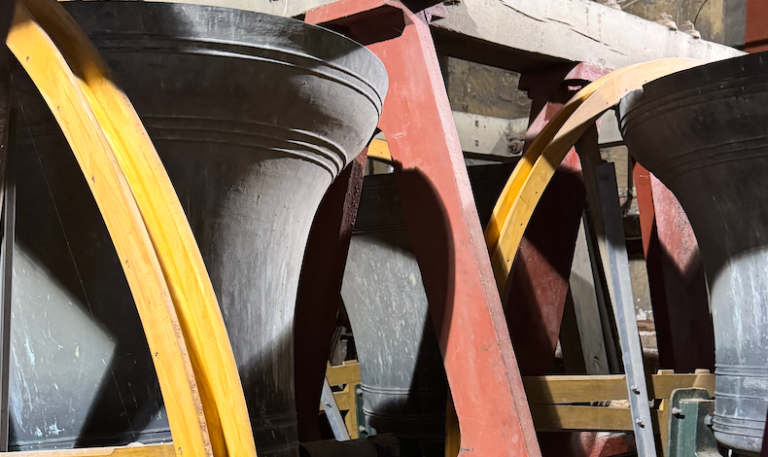
The bells at St Cuthbert’s are tuned to the key of Db, the Tenor bell weighing 27 cwt. The two oldest bells in St Cuthbert’s are 17th century:
- Tuned to G, the oldest bell (cast in 1664 by Robert II Austin) was found to be cracked in 1992 and is now displayed in the church. Its replacement is a Dutch bell cast by Eijsbouts and is tuned to Gb so as to fit in better with the scale of Db major of the other bells
- Tuned to Bb, the second oldest bell is still in use and was cast in 1683 by Thomas Purdue (the 3rd of the current ring of 8 bells)
It is likely that the bells were made up to a set of six in or around the 1780’s. Two of these bells are still in existence cast in 1785 (current 6th bell) and 1787 (current tenor) by William Bilbie. The last major work on the bells was completed in 1888 as a jubilee project when they were made up to a set of eight by Taylors of Loughborough. Two new bells funded by the local ringers were added (the current trebles). Of the original 6 bells, the 5th (the current 7th bell) was found to be cracked and was recast. The original 2nd bell was also recast. A report of the dedication service can be found in “The Bell News Vol 6 No. 312″ p614 (Saturday, March 17, 1888)“. The frame is of an unusual design based on a fixed lower wooden frame and a floating upper wooden frame. In between, an A frame contains the ball-bearing mounts on which each bell is hung. When the replacement for the 1664 Austin bell was cast in 1992, the opportunity was taken to add a ring beam to the tower as there were concerns that the weight of the bells were affecting the fabric of the tower. The successful addition of a new rope guide for the front 6 bells in 2015 is the latest work to be completed in the tower to help bell handling due to the long draft.
Evidence still exists in the ringing chamber of:
- The original chiming mechanism (although the ropes and some of the hammers have gone) that allowed tune ringing to be achieved
- Gas light fittings that were used prior to electricity arriving in the tower
- An internal chiming mechanism on small bells (used when the bells were silenced) to allow ringing to continue during WWII.


Dove’s Guide for Church Bellringers gives details of each of the bells. The ringers at St Cuthberts are affiliated to the Glaston Branch of the Bath and Wells Diocesan Association of Church Bell Ringers