loading...
Powered by Pretty Google Calendar


Change ringing on handbells is traditionally performed by each person ringing two bells at a time – one in each hand. The group at Wells regularly meet on Monday evenings, practicing anything from minor up to Plain Hunt Maximus.
Quarter Peals and Peals are also regularly rung.
New members are welcome to approach us with a view to learning the “art” and “science” of using handbells for ringing.

The bells at St Cuthbert’s are tuned to the key of Db, the Tenor bell weighing 27 cwt. The two oldest bells in St Cuthbert’s are 17th century:
It is likely that the bells were made up to a set of six in or around the 1780’s. Two of these bells are still in existence cast in 1785 (current 6th bell) and 1787 (current tenor) by William Bilbie. The last major work on the bells was completed in 1888 as a jubilee project when they were made up to a set of eight by Taylors of Loughborough. Two new bells funded by the local ringers were added (the current trebles). Of the original 6 bells, the 5th (the current 7th bell) was found to be cracked and was recast. The original 2nd bell was also recast. A report of the dedication service can be found in “The Bell News Vol 6 No. 312″ p614 (Saturday, March 17, 1888)“. The frame is of an unusual design based on a fixed lower wooden frame and a floating upper wooden frame. In between, an A frame contains the ball-bearing mounts on which each bell is hung. When the replacement for the 1664 Austin bell was cast in 1992, the opportunity was taken to add a ring beam to the tower as there were concerns that the weight of the bells were affecting the fabric of the tower. The successful addition of a new rope guide for the front 6 bells in 2015 is the latest work to be completed in the tower to help bell handling due to the long draft.
Evidence still exists in the ringing chamber of:


Dove’s Guide for Church Bellringers gives details of each of the bells. The ringers at St Cuthberts are affiliated to the Glaston Branch of the Bath and Wells Diocesan Association of Church Bell Ringers

“Noisiest of the unseen servants of the Cathedral, but least heard of, are the ringers.” Thus began a pamphlet entitled ‘Wells Bells’ – an extract from the Friends of Wells Cathedral report from 1971.
Wells Cathedral has the heaviest ring of ten bells in the world. The tenor bell, known as ‘Harewell’, weighs 56¼ cwt and is the fifth heaviest ringing bell in the world following the tenors of the rings of twelve at Liverpool Cathedral (82cwt), Exeter Cathedral (72½ cwt), St. Paul’s, London (62 cwt) and York Minster (59¼ cwt). The ring is in the key of C. All the ringable bells are housed in the southwest, or Harewell Tower to which the bells have been moved in stages.
Three millennium chiming bells (“Faith”, “Hope” and “Charity”) hang in the north-west tower and are used as service bells and to ring the midday Angelus.
Six clock bells also exist that chime the quarters and hours – these are controlled by one of the oldest medieval clocks in the North Transept above the Virgers’ office. Although the current third mechanism is Victorian (Gillett and Johnston, 1887), the original mechanism still works and is now in the science museum. The second 1830s mechanism was not large enough to operate six clock bells as well as two clock faces and is now at Burnham church. The hour bell is at the top of the central tower, while two bells kicked by knights chime the quarters outside near the north porch that faces the medieval Vicars’ hall and chapter houses. Three further small bells chime the quarters and hours inside, operated by Jack Blandiver next to the medieval clock face in the north transept. The local pub “The Quarter Jack” in Wells is named after him.
Bells appear to have originally been hung in the lantern, i.e. the central portion of the central tower roof, soon after it was built (c 1215 – 1220). The first record of bells in Wells Cathedral was in 1226 when Bishop Jocelin asked for bell ropes to be purchased for the Cathedral. At the time, the Bishop lived on south side of the cathedral in the newly built Bishop’s Palace and the Canons on north side (as they do now). Bells were therefore used to call the Canons to meetings at St Mary’s Chapel in the Camery Gardens. The lantern is frequently referred to as the ‘Belfry’ from 1297 onwards, at a time when it rose no higher than the level of the main roof.
A sacristan was soon employed for knolling the bells during prayers and Masses for the dead that became an important part of the Cathedral’s work in the chantry chapels. The income from these bequests was an important part of the Cathedral’s income until the reformation.
Work on raising the central tower began in about 1315, and it was roofed in 1322 – almost certainly with a lead-covered spire destroyed by fire in 1438. By 1338 the sinking of the foundations on the West side caused it to crack and the bells Peter, Dunston, Bytton and ‘the small bell’ were transferred to a temporary bell-tower ‘near the Deanery’. This may have been the base of the Northwest tower, or in a wooden bell-cage on the green. The latter seems more likely since repairs were later necessary to the wooden ladder on the ‘old Northern bell-tower’. Since the Western towers have good stone stairs there would not appear to be any need for wooden ladders.
During his lifetime, Bishop Harewell gave two-thirds of the cost of the Southwest tower. He also gave two bells, the new tenor, known as Great Harewell, and another called Little Harewell. In 1414-5 all six bells were hung or rehung in the South-West tower.
The Cathedral bells are based on a set of eight cast by Abel Rudhall in 1757. The bells were augmented to ten in 1891 by the addition of two Whitechapel trebles and installed in a new iron framework by Blackbourne and Greenleaf of Salisbury.
The successful addition of a new rope guide for the front 6 bells and new decor in December 2016 is the latest work to be completed in the tower.
Points of interest in the ringing chamber are:
Dove’s Guide for Church Bellringers gives details of each of the bells (opens in a new window)
The ringers at Wells Cathedral are affiliated to the Glaston Branch of the Bath and Wells Diocesan Association of Church Bell Ringers
Find Wells Cathedral (opens in a new window)
Enter Wells Cathedral web site (opens in a new window)
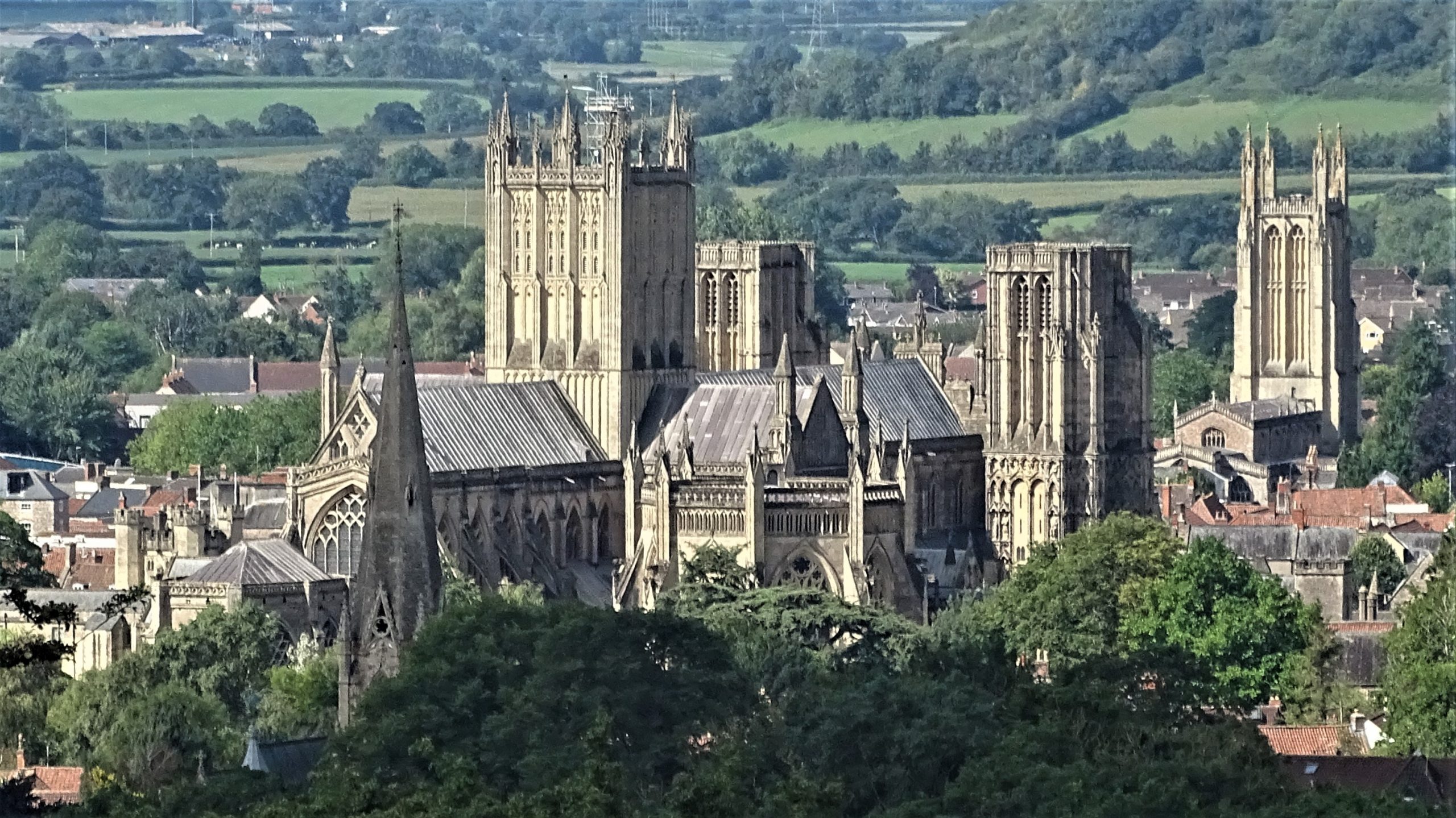
Although it is the smallest city in England, Wells has three C-of-E churches, two of which contain bells that can be rung “English style” (seen left to right above).
An active handbell group also meet regularly on Monday evenings and welcome new members.
Ringing is currently organised by an active group of ringers called the “Wells Amateur Bellringing Society” (more affectionally known as WABS). The group has been in existence since 1875, although bells have been around in Wells for much longer.
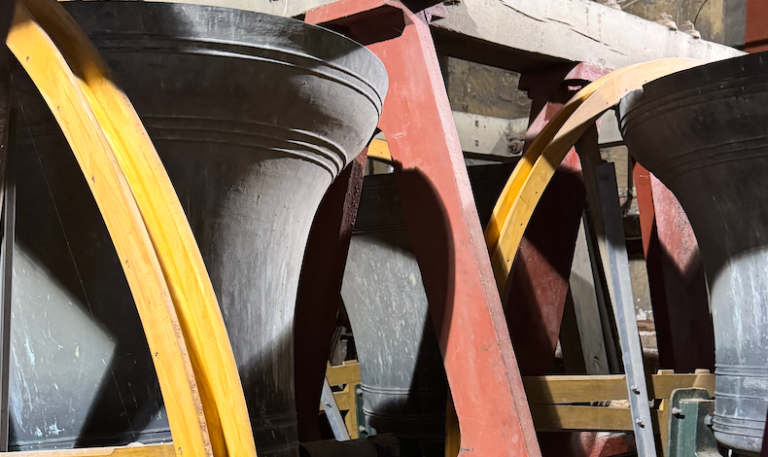
Wells Bells Project
Help us enhance and restore one of the most recognisable sounds in Wells

