Introduction
If you stand amongst the gravestones on what is now the green in front of the Wells Cathedral west front and admire the stories being told by the rows of statues, you will see from top down:
- Jesus witb two seraphim either side.
- The apostles with St Andrew (The patron Saint of the cathedral) in the centre.
- A row of statues showing the dead rising from their graves on Judgement Day.
This story in the statues depicting the resurrection was an important part of Christianity in England up until the reformation. In Wells, a sexton was employed to ring the Death Knell bells from 1230’s onwards as masses were said at each of the chantries and chapels inside the cathedral
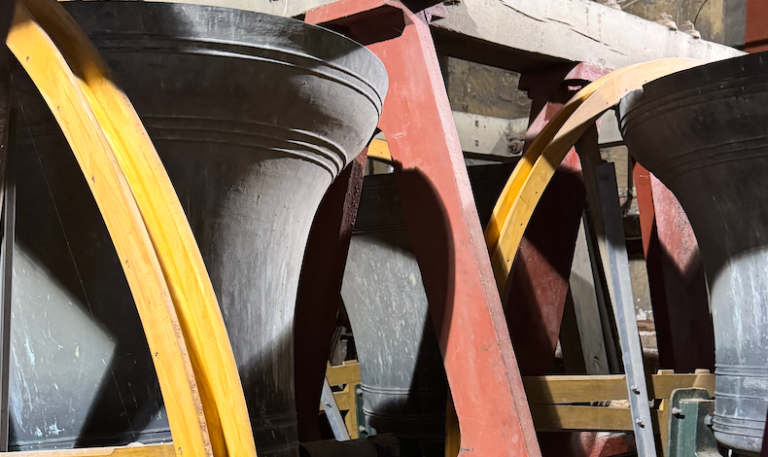
“Knolling” the bells refers to the slow, solemn tolling of a church bell to mark a death or funeral, a tradition rooted in centuries of English custom to ward off evil spirits, request prayers for the deceased, and announce the news to the community. Historically, the number of tolls was meticulously regulated to communicate the gender and social standing of the deceased.
Origins and Evolution
Ancient Rituals
Church bells were believed to protect the soul of the dead from evil spirits as they passed to the next world. They were rung as a person was dying (the Passing Bell), on his/her death (the death knoll) and later the lych bell at the lych gates of the church as the coffin arrived.
The Passing Bell
Historically, a bell was rung when a person was dying — the ‘passing‘ bell — to request prayers for their soul and warn of demons, a tradition that predates modern funeral customs. It is the use of this bell that is referred to in the quote by John Donne in 1624; ‘Ask not for whom the bell toll – it tolls for thee.’
The Death knell
Traditionally, the death knell was tolled as soon as the church received news of a death – unless it was after sunset when the knell was rung the following day. It was rung in patterns to identify the deceased; typically one stroke for a child, two strokes for a woman and three for a man, often followed by a number of tolls indicating the person’s age. These ‘Tellers‘ evolved into the word ‘Tailors‘ from which Dorothy L Sayers got the name of her Lord Peter Wimsey novel ‘The nine tailors’.
The death knell is still used today 800 years later on the passing of a monarch and occasionally at other funerals.
The Lych bell
As the death knell was rung upon one’s death, so a ‘lych‘ or ‘funeral‘ bell was tolled as a funeral procession approached the lych gate of the church. This tradition was particularly prevelant in Sussex and Kent where many elaborate lych gates still exist.
Reformation Impact and Changes in Regulation
During the reigns of Henry VIII and Elizabeth I, excessive tolling was restricted to prevent “superstitious” practices, sometimes restricting it to a single bell before a sermon
19th Century Customs
By the late 1800s, it was common to ring the knell immediately upon receiving notice of a death, unless it was after sunset, in which case it was deferred until morning.
Modern Day
While many traditional funeral tolls fell out of use, the practice survives for royalty or within specific community customs, often now managed by automated systems rather than a church sexton.
Distinction from Change Ringing
Unlike “change ringing,” which is the fast, musical ringing of a full peal of bells, knolling is a slow, methodical tolling, often with one bell. The largest tenor bell was usually used – or where larger churches had the facilities, a separate large ‘bourdon’ bell.